
Sheet music in detail
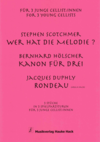
Three trios for young cellists

About the composers
Bernhard HoelscherBernhard Hoelscher (1923-2015) was one of the first students after the Second World War, who studied piano, organ and composition in Cologne. He got inspiration from the atonal music which was forbidden in Germany until 1945.
In 1948 Bernhard Hoelscher won the first prize at a composition competition in Cologne with his Cello sonata, which was published in 2005 in Musikverlag Hauke Hack. More pieces of Mr. Hoelscher are published here. His personal style which is familiar with church modes is recognisable throughout his works.
Stephen ScotchmerStephen Scotchmer (*1955) studied music at the University of Bristol and conducting with Arthur Davison. During his many years as musical director of the Basingstoke Symphony Orchestra, he conducted a large part of the standard repertoire for both orchestra and choir, including performances of all of Beethoven's and Brahms's symphonies, "A Child of Our Time," and Verdi's Requiem. He had the privilege of working with some of Britain's finest musicians, including Lesley Garrett, Kathryn Stott, Anthony Marwood, Martin Roscoe, James Lisney, Natalie Clein, and Martino Tirimo.
As a composer, Scotchmer has written an extensive body of work in many different genres. His style is predominantly tonal, and the compositional techniques he employs are traditional. His interest lies more in the manipulation of the various musical elements that determine perceived expression in music than in the exploration of sound as a science.
The works for cello were written for his daughter, the cellist Lucy Scotchmer.
Jacques DuphlyJacques Duphly (1715-1789) was a French composer, harpsichord player and organist.
About the composition
Stephen Scotchmer: "Who has the Melody?"
Bernhard Hölscher: Canon for three
Jacques Duphly: Rondeau
Stephen Scotchmer: “When I wrote this composition, I wanted developing cellists to experience many of the musical elements that they would encounter later on in their development - imitation, counter-melodies, sequences and interesting harmonies. Hopefully, young players will enjoy learning how to be at the forefront (playing the tune), or accompanying (playing the countermelodies).”
Bernhard Hölscher's Canon from 1996 is a simple, cheerful melody and is presented here in two versions. The C major version is limited to the close first position. The F major version also requires the B-flat on the A string. Octaves to the thumb position can easily be made for pedagogical reasons. Individual text verses can also be wonderfully created, for example, one verse from each cellist.
Jacques Duphly's 18th-century rondeau was originally written for a keyboard instrument. The arrangement for three cellos is in C major. Due to the piece's polyphonic structure, all three parts are very important, even though the melody stays entirely in the first cello part, which places somewhat greater demands on the cellist in terms of tonal range, especially since some interval leaps occur.