
Sheet music in detail
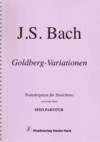
Goldberg Variations
About the composer
Johann Sebastian BachJohann Sebastian Bach (1685-1750)
“Bach is the beginning and end of all music.” (Max Reger)
“Not Bach! (Bach means small river in German.) He should be called Sea: because of his endless, inexhaustible wealth of tonal combinations and harmonies.” (Ludwig van Beethoven)
“Now that's something we can learn from. (About the music of J. S. Bach)” (W.A. Mozart)
About the composition
J.S. Bach: Goldberg-Variations, Version for String Trio (Arr. Armin Behr), 3 performance scores
Armin Behr:
"For this arrangement of the Goldberg-Variations I have consulted three existing arrangements together with various harpsichord editions. These arrangements are the established and innovative one by the violinist Dmitry Sitkovetsky, the one by the viola player Annette Bartholdy and the independent one by the cellist Federico Sarudiansky, which gave me much valuable inspiration.
Sitkovetsky proved the transferring of the Goldberg-Variations on to only three string instruments is practical and possible without the loss of any musical substance. Where he changes his role of arranger to that of adaptor, particularly in Variation 20, Miss Bartholdy follows closely Bach’s text. Sarudiansky finds his own interesting solutions, e.g. in the conversion of the “a 2 Clav.” variations. However I do not follow his solution of partly composing a voice in addition to three continuous parts.
In my edition I have sought different ways of distributing the double stopping in the four part variations. As far as possible there should not be any technical difficulties, especially in the outer parts, which might inhibit a fluent and good sounding performance. Following the printed text I have distributed on to several instruments the small motives in the variations “to be played on two keyboards” despite requiring increased rhythmic precision.
I try to avoid extreme positions and scales in double stops by changing instruments so that for instance the variations 17 and 23 can be performed not only by professional virtuosos.
Producing this edition as a players’ score requires a closely printed text which gives the advantage that all the players have access to all musical information all the time."
The 3 players’ scores are in a ring book of 70 pages each.